Designing services people have to trust
£3.1m
forecast saving, contingent on a form I redesigned
46%
of GP practices using online consultations
95.8%
clinician agreement with AI triage
The ask: make dozens of services feel like one app
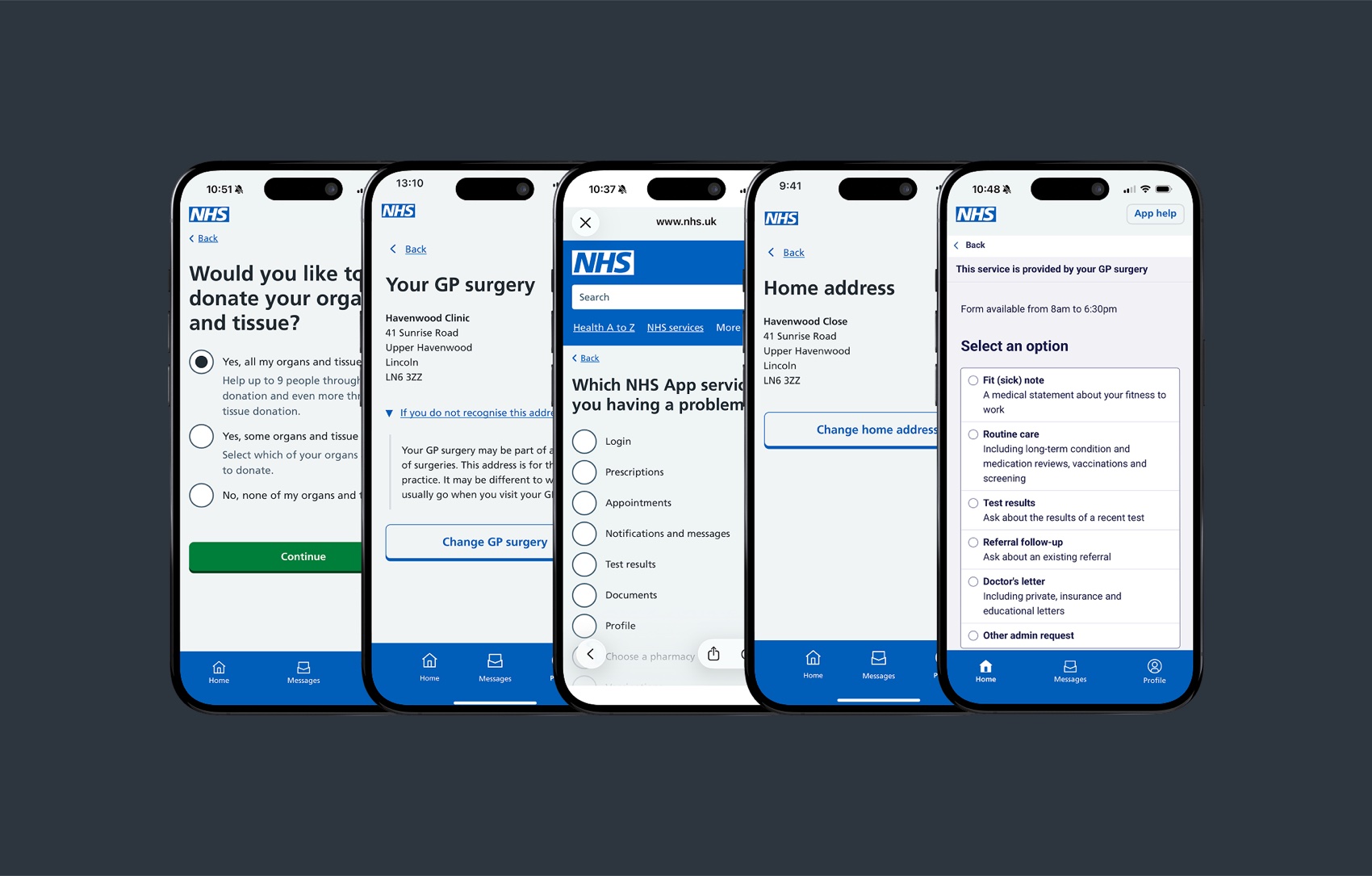
The NHS App is only as good as the services behind it, and most of those aren’t built by my team.
GP systems, booking services, triage tools, each built by a different product team, to a different standard, at a different level of quality. My team assesses, designs and delivers the integrations that bring them into the app, so when a patient moves from booking an appointment to a triage conversation to a consultation, it feels like one service instead of a dozen stitched together.
A £3.1m saving depended on this redesign
The service-management contact form is how feedback and problems flow through the whole app. It was being sunset as part of a Zendesk to ServiceNow migration, on a hard deadline, and the migration’s forecast £3.1m saving by FY28/29 was written down as contingent on this form being redesigned to cut manual handling. If the redesign didn’t work, the saving didn’t materialise.
The pressure was to port the old form as-is and hit the deadline. I pushed back. It front-loaded far more free text than it needed, and every extra field was manual work downstream, plus clinical risk. So I fought for a minimum required dataset: the smallest set of information that still does the job. Fewer fields, less free text upfront, faster to build, less to handle at the other end.
37%
fewer cases submitted
42%
fewer returning visitors
60%
more automated fixes sent to users
67%
fewer clinically sensitive tickets*
We shipped ahead of schedule, nationally. Cutting the dataset is what made the automation possible, which is the part the £3.1m forecast needed.
The definition of a clinical ticket changed in the migration, so this figure isn’t a strict like-for-like comparison.
The first NHS AI triage system
Triage is where AI in healthcare either earns trust or loses it, so this is the one watched most closely. It went live in pilot at a four-site partnership serving over 12,000 patients, brought in to handle same-day demand that was outrunning supply.
The pilot cut phone-queue volumes by 29%, and it’s now on a national path: rolling out to 200,000 London patients first, then to all NHS App users by 2028.
Underneath that headline, the numbers that made it safe to scale:
73%
of same-day requests safely de-escalated to routine care
3 min
average triage time per case
95.8%
clinician agreement with the non-urgent classifications
Fast triage is easy. Triage a clinician agrees with is not, and 95.8% is what makes it safe to rely on.
One standard, a dozen external teams
Aligning a dozen external teams needed a standard they could see and measure themselves against.
I defined a product assessment every integration runs through, against the NHS Service Manual, the NHS Design System and WCAG 2.2. Then I ran it continuously with each third-party team using a MoSCoW approach, so everyone could see exactly what had to improve, accessibility included, before their service went near the app.
Reaching everyone, not just most
Before handing online consultations to the GP Services team, my team delivered them nationally: 46% of GP practices, 84% of trusts in London.
Patients say what they care about most is getting a GP appointment, and online consultations go straight at that. Not a feature, one of the biggest friction points in the system, addressed at national scale.
But national scale only means something if it works for the whole public, not most of it. So I ran the team’s release testing on BrowserStack and iOS VoiceOver. On a health service everyone uses, accessibility isn’t a checklist item. It’s the line between something that works for everyone and something that quietly doesn’t.